Have you ever said to yourself, “I don’t want to sell because I will have to pay taxes”?
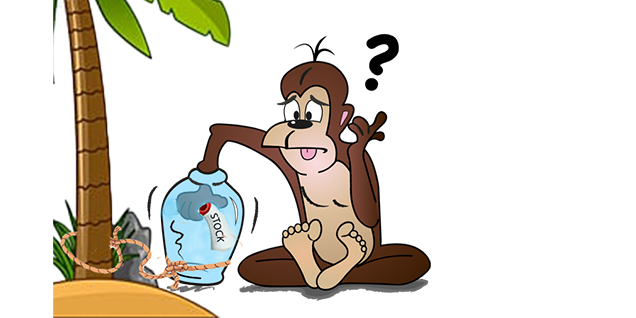
The “South Indian Monkey Trap” mentioned in the book, Zen and the Art of Motorcycle Maintenance, by Robert Pirsig, is a metaphor for being trapped due to not letting go of something.
The monkey has his hand stuck in a jar that is tied to a tree. The reason his hand is stuck in the jar is because he will not let go of the fruit in the jar.
Human nature drives us to keep winners and sell losers, especially if the winners include paying taxes on the gain. We all like to say, I own XYZ stock, and I have made an incredible return on this stock. This gives the impression that all of our selections have had similar results. Daniel Kahneman spoke to this as the endowment bias, in his book titled, Thinking Fast and Slow. The endowment bias is the behavioral trait that leads us to believe that what we own has more importance than it is truly worth. The consequence of this behavior is our losses and gains seem much greater than they truly are.
Let’s look at some common examples of how not selling for taxes can affect your wealth. I am going to show you three different stocks.
Nvidia had a return of over 171% for 2024. If you invested $100K in this stock on December 31, 2023, you would have had $271,254 in your account at the end of 2024. If you sold the stock on December 31, 2024 you would have had a tax consequence of $25,688, provided you were in the 15 percent capital gains bracket. If you did not sell, today you would have a loss of $55,714 from your value on December 31, 2024. The loss is more than double what the tax liability was.
The following table gives an example of two companies and one ETF. The companies are Nvidia, KKR (private equity firm), and SPY (ETF which represents the S&P 500 index).
|
NVDA |
KKR |
SPY |
| Tax Payment for 2024 Year |
$25,688 |
$11,946 |
$3,745 |
| 2025 Loss (as of 3/11) |
($55,714) |
($49,974) |
($4,979) |
|
|
|
As you can see in each case, the amount of the tax payment for 2024 is less than the loss each stock has experienced since the beginning of 2025. While holding the stock will allow you to say I currently have a positive return in the stock, there is no denying your actual wealth is less than if you would have sold and paid the taxes.
Beware of holding on to a position which is trading at an extreme to its relative value. When evaluating your stock position, it is important to ask a vital question. Would I buy more of the stock at its current price? Try to make sure you are not trapped to a market because your hand is stuck in a jar holding on to a risky stock.
You can refer to the IRS capital gains tax rates here.
Notes and Disclaimers
This document and the information contained herein are for educational and informational purposes only and do not constitute, and should not be construed as, an offer to sell, or a solicitation of an offer to buy, any securities or related financial instruments. Responses to any inquiry that may involve the rendering of personalized investment advice or effecting or attempting to effect transactions in securities will not be made absent compliance with applicable laws or regulations (including broker dealer, investment adviser or applicable agent or representative registration requirements), or applicable exemptions or exclusions therefrom.
This document, including the information contained herein may not be copied, reproduced, republished, posted, transmitted, distributed, disseminated or disclosed, in whole or in part, to any other person in any way without the prior written consent of Core Capital Management & Research, Inc. (“Core Capital”)
This document contains information and views as of the date indicated and such information and views are subject to change without notice. Core Capital has no duty or obligation to update the information contained herein. Further, Core Capital makes no representation, and it should not be assumed, that past investment performance is an indication of future results. Moreover, wherever there is the potential for profit there is also the possibility of loss.
Certain information contained herein concerning economic trends and performance is based on or derived from information provided by independent third-party sources.Sources in this article include the Federal Reserve, Yahoo Finance, BEA, and NBER. Core Capital believes that such information is accurate and that the sources from which it has been obtained are reliable; however, it cannot guarantee the accuracy of such information and has not independently verified the accuracy or completeness of such information or the assumptions on which such information is based. Moreover, independent third-party sources cited in these materials are not making any representations or warranties regarding any information attributed to them and shall have no liability in connection with the use of such information in these materials.