
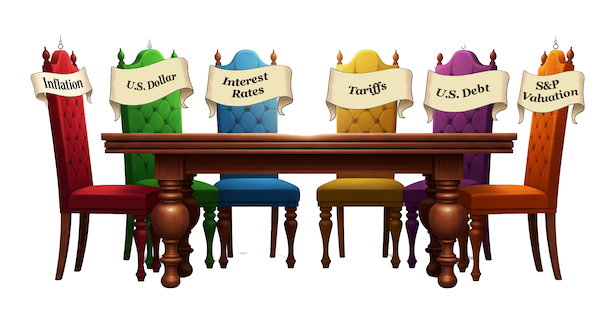
Sooner or later, every market participant is exposed to a market correction, which, if not prepared for, can destroy years of capital gains and take years to recover from. For example, according to John Hussman, despite all the gains the stock market enjoyed during the “tech bubble” and the subsequent “mortgage bubble,” the decline to the March 2009 market low erased the entire total return of the S&P 500, over and above T-bill returns, all the way back to May 19951. Fourteen years of gains were gone.
Investors who relied on distributions from their accounts to fund charitable foundations, family trusts, and everyday expenses in retirement were suddenly faced with the consequences of following pundits and advisors. From their high perch, these advisors preached the soundness of momentum and growth investing.
Samuel Johnson, an accomplished English writer from the 1700s, once spoke of the triumph of hope over experience. While he was often believed to be speaking about second marriages, he could just as easily have been talking about the majority of the investing public, including both professional and retail investors.
Every boom-bust cycle ends with investors moving away from stable, steady, and dependable strategies and into more aggressive, dangerous, and wealth-destroying ones. They “hope” that this time will be different. Regardless of centuries of data proving this to be an unsound judgment, they are unable to resist the emotional lure of chasing the most recent and popular “get rich quick” investment strategy.
It has always been the style of Core Capital Management & Research to invest in more defensive market sectors and select individual companies in those sectors that have a large market share. We base our investment decisions on valuations that have proven to have predictive results over the last 56 years. This style of investing has consistently provided investors with excess returns across a range of market cycles.
The difficulty with this type of investing lies in having the patience and discipline to set aside recent returns as an indicator of future performance.
Investing in value companies and hard assets is like using a freighter to cross the Atlantic Ocean instead of a speedboat. With calm seas and good weather, the speedboat will cover the ocean faster. Many times, the speedboat will appear to be far ahead of the freighter. This is until a storm and rough seas arrive. If the storm is strong enough, the speedboat will be destroyed. This is the consequence of relying on hope and not preparing for bad weather. One thing we know for sure is that there will always be stormy weather in investing; you just don’t know when it will happen.
Still, there will be investors who choose to ride in the speedboat. These investors have had lady luck and smooth sailing go their way over the last two years. Here are a few facts that these fortunate ones have chosen to ignore:
- Government Debt at $37 trillion and climbing.
- Debt is now 120% of GDP.
- Government budget deficit of $1.9 trillion.
- Fed balance sheet is now at $6.6 trillion2.
On four major occasions—1998, 2001, 2008, and 2020—the Fed and Congress used the tools at their disposal to hand Wall Street a lifeline. They bailed out rotten market participants and heedlessly injected cash into the system to kick-start the economy. As a result, growth and financial assets have cycled through bubble after bubble, giving investors the false sense of security that this recent market return cycle is more than just leveraged-induced. The general market consensus is that the previous two-year performance is a trend and not a long-term aberration.
This leveraged market has had further unintended consequences. Foreign investors have begun to recognize this irresponsible behavior.
- The US Dollar has seen its worst start to the year in 50 years.
- The US Dollar Index has reached its lowest level since the Nixon years3.
- Saudi Arabia is slowly moving away from the petrodollar agreement with the US4.
- De-dollarization is unfolding in central bank reserves, where the share of USD has slid to a two-decade low.
- The share of foreign ownership in the US Treasury market has fallen over the last 15 years, pointing to reduced reliance on the dollar5.
When markets move away from the US Dollar and start selling US Treasury bonds, this will drive interest rates higher. Higher interest rates will crush the discount rates for growth stocks and financial stocks, ultimately leading to lower prices for these assets.
Households are also becoming increasingly squeezed by credit.
- US household credit card debt is at a record high of $1.21 trillion6.
- The slowest pace of existing home sales since 19957.
This leaves the consumer with little room for durable goods spending, which will lead producers to reduce inventories and increase capital saving—thus reducing growth. Combine this with low wage growth and rising prices, and it’s difficult to predict outsized growth.
Economic data is not the only metric showing warning signs. The S&P 500 is at extreme valuations. The Shiller cyclically adjusted PE ratio is currently at 37.87. This is the highest it has been since December of 2021, when the market corrected over 18% in the next year. The previous time we had a higher cyclically adjusted PE ratio was in November of 20008. The market then lost over 40% of its value before starting to recover.
This information isn’t new. Markets have looked at this information, and like storm chasers after a tornado, they refuse to recognize the warning signs.
Investor psychology has historically moved between over-optimism and over-pessimism. For example, in the last 25 years (from 2000 to 2024), the market has had eight years with returns greater than 20%. Nearly one-third of all these years had returns greater than 20%. Even with this incredible fact, the market has only had a real return of 7.70% during this time period9. This confirms the manic behavior of the market, driven by over-optimism pushing prices up and over-pessimism driving them down, rarely using rational judgment based on long-term facts.
Let me give you another indicator of an over-priced market. The S&P 500 has just come off two years of excessive returns, 26.29% and 25.02% (2023-2024). This has happened during a ten-year period that has averaged over 13% per year (2015-2024)9. These returns have been driven by the riskiest market sectors, including Technology, Telecommunications, and Consumer Cyclicals. This outsized two-year return with an outsized ten-year return has historically been an indication of a market high with an impending correction.
“Ceteris paribus,” or “all other things being equal,” each market correction is led by some form of failure. The 2008 correction started with the collapse of Lehman Brothers. The 2000 market correction started with the failed merger of AOL and Time Warner. While not the only cause, the Fed raising interest rates also contributed to the market correction. We have seen the Fed raise interest rates again; the question becomes what will be the trigger that leads to the next correction. Could it be the failure of a large private equity firm? They are unquestionably over-leveraged. Could it be the result of a belligerent government policy to strong-arm international trading partners with excessive tariffs, leading to a primitive and violent retaliation?
The answer is no one knows. The real answer is: How do we prepare?
The first and most important thing is to realize that we are in the upper range of the cycle. Markets have been driven by speculation, growth, and financial assets. The best-performing indexes have been momentum-driven. Markets have gone up not based on valuations, but on investors buying because prices are going up.
Next, if you look at long-term secular movements in market cycles, we are in a different era than we were 20 years ago. Low inflation, excessive government spending, and low interest rates have run their course. Geo-political stress, which is affecting sea lanes and shipping security, will lead to higher prices. Currency risk, caused by countries challenging for world dominance, leads to low confidence by risk-takers to create new opportunities. We no longer live in a world where, unfortunately, we can take US dominance of power for granted. Since the end of the Cold War, we have had very few legitimate challenges to our will. We could, for the most part, establish calm in the world. This has changed. Military confrontations across Africa, Israel, Pakistan, Turkey, and Ukraine have made this a much more dangerous world.
While countries like China and Japan continue to hold billions of dollars of US debt10, we can no longer rely on foreign governments to buy our unrestrained debt at current levels to keep interest rates low. The current administration has openly communicated they will reduce our reliance on foreign manufacturing, reducing our ability to export our inflation and import deflation through globalization. All of these changes will ultimately lead to inflation and higher interest rates. This will create a secular movement of investors from growth and financial assets to value and hard assets.
In the years 1907, 1929, 1972, 2000, and 2008 the market narrative was dominated by very loud voices with very recent outsized investment performance trying to convince investors to move away from stable investments and follow them down the leveraged path of growth investing and risk taking. Like Icarus who discarded his father’s warning about flying too close to the sun, following the advice of these ambitious, loud voices, will evidentially lead to losing your wings and drowning in a sea of lost wealth.Those investors who stay the course of investing in value and hard assets will, like in all previous cycles, benefit from their disciplined choices.